




By 3D North Star Freedom File
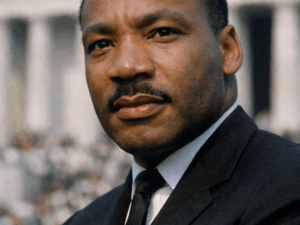
Dr. Martin Luther King Jr.: More Than a Dream, A Drumbeat for Justice
More than half a century after his assassination, Dr. Martin Luther King Jr. remains not just a historical figure, but a living moral force.
His voice still echoes in the chants of protestors demanding dignity, justice, and freedom.
His legacy lives not only in the memory of a movement, but in every struggle that insists America live up to its own promises.
To remember Dr. King honestly is to remember that he was not simply symbolic—he was disruptive, disciplined, and deeply committed to uprooting injustice at its core.
Born on January 15, 1929, in Atlanta, Georgia, Martin Luther King Jr. was shaped by the Black church, Southern segregation, and a theological belief that injustice anywhere was a threat to justice everywhere.
That conviction would become the foundation of his life’s work.
Yet reducing King to a soft-spoken dreamer is one of the greatest distortions of American history. He was radical in the truest sense—committed to confronting and dismantling oppressive systems, not simply softening their edges.
King rose to national prominence during the 1955 Montgomery Bus Boycott, sparked by Rosa Parks’ refusal to surrender her seat.
At just 26 years old, he became the face of a movement that challenged the foundation of Jim Crow segregation.
For 381 days, Black residents of Montgomery walked instead of riding segregated buses, enduring threats, harassment, and violence. The boycott succeeded not because of polite appeals, but because of disciplined resistance, collective sacrifice, and moral clarity.
Not Passivity
For King, nonviolence was never weakness. It was confrontation without hatred and resistance without surrender.
It exposed the brutality of the oppressor while preserving the dignity of the oppressed.
A Moral Weapon
Drawing from the teachings of Jesus Christ and Mahatma Gandhi, King turned nonviolence into a disciplined strategy for social transformation.
This philosophy guided movements in Birmingham, Selma, Albany, and beyond.
In 1963, standing before the Lincoln Memorial during the March on Washington for Jobs and Freedom, King delivered his now-iconic “I Have a Dream” speech.
But even that moment has often been sanitized. The march was not only about symbolism—it was about jobs, wages, voting rights, and an end to police brutality.
King’s dream was not abstract inspiration. It was a demand for structural change.
As the years progressed, King’s analysis deepened. He spoke more directly about economic inequality, calling the excesses of capitalism immoral.
He launched the Poor People’s Campaign to confront poverty across racial lines and condemned the Vietnam War, naming the United States “the greatest purveyor of violence in the world today.”
These positions made him even more dangerous to the establishment. He was surveilled by the FBI, criticized by politicians, and condemned by white moderates who preferred order over justice.
On April 4, 1968, Dr. King was assassinated in Memphis, Tennessee, where he had traveled to support striking sanitation workers—Black men demanding fair pay, dignity, and safe working conditions.
His death sent shockwaves across the globe.
But the work did not die with him. It passed into the hands of those willing to continue the struggle, generation after generation.
Honoring Martin Luther King Jr. requires more than repeating quotes or unveiling statues.
It requires confronting voter suppression, mass incarceration, racial wealth gaps, police violence, and the continued assault on Black life.
King warned against complacency. He warned against confusing symbolic progress with real justice. His legacy demands courage, not comfort.
In one of his final sermons, King said he did not want to be remembered for honors or titles.
He said that if people remembered him at all, let them say he was a drum major for justice.
That drumbeat has never stopped. It sounds in every act of resistance, every demand for dignity, and every refusal to let injustice define the future.
Dr. King’s dream was never meant to put us to sleep. It was meant to wake us up.